
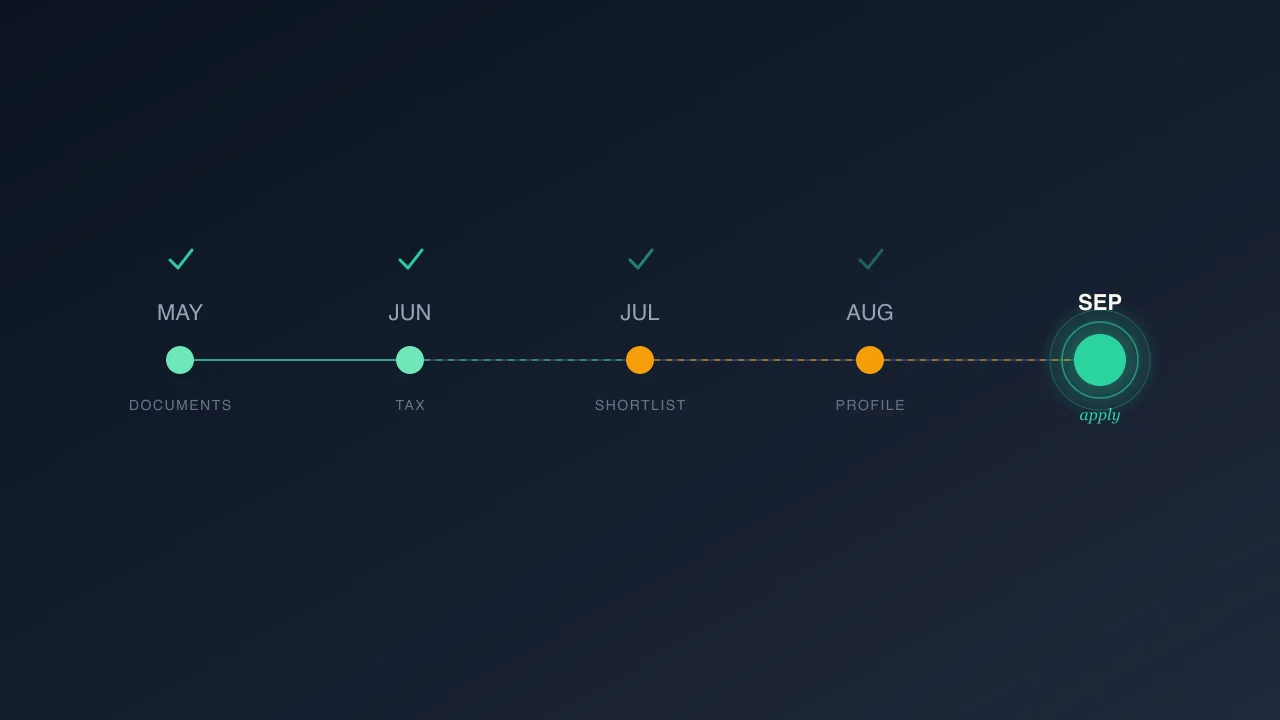
NSFAS is the most important financial tool in South African higher education. For households earning under R350,000 a year, it covers tuition, accommodation, meals, learning materials, and transport — at every public university and every public TVET college. For families who qualify, it's often the difference between "my child is going to study" and "we can't afford it."
It's also one of the most fumbled application processes in the country.
The application itself takes about 30 minutes online. The paperwork around it — collecting documents, verifying details, sorting out tax issues, tracking down family members for ID copies — is what catches most parents off guard. Applications that fail almost never fail because the family didn't qualify. They fail because something was missing, or wrong, or filed too late.
NSFAS 2027 applications typically open in September 2026 and close end of January 2027. That sounds like plenty of time. It isn't.
Here's how to use the months before September so that when the application opens, your part is already done.
Why this matters more than parents realise
NSFAS approvals depend on getting the income, household, and academic information exactly right the first time. The most common rejection reasons are not "household earns too much" — they're administrative:
- A parent's SARS records show income above R350,000 even though current take-home is below (back-pay, severance, an old company car still on payroll)
- A parent or guardian listed on the application doesn't have valid SA documentation ready to upload
- The household composition on the form doesn't match what's on Home Affairs records
- Marriage certificates, divorce decrees, or death certificates aren't on hand to prove household status
- Matric exam registration details don't match the NSFAS application
Each of these takes weeks to fix once flagged. If the fix happens after the deadline, the application is dead — and there's no second cycle that year.
The pre-application checklist by month
May–June 2026: Documents
These are the documents you'll need ready to upload:
For your matric student:
- [ ] Certified copy of green-bar SA ID (not the smartcard? — both work, but make sure the ID is valid)
- [ ] Matric exam registration confirmation (Department of Basic Education sends this; check it matches their ID exactly)
- [ ] Proof of address (a recent utility bill or signed affidavit)
For each parent/guardian listed in the household:
- [ ] Certified copy of SA ID for everyone over 16 in the household
- [ ] Latest payslip OR proof of income (3 months)
- [ ] If self-employed: bank statements (3 months) and an affidavit of average monthly income
- [ ] If unemployed: an affidavit confirming unemployment status, signed at a SAPS station
- [ ] If receiving a SASSA grant: the grant approval letter
For the household, if applicable:
- [ ] Marriage certificate (if married)
- [ ] Divorce decree (if divorced — must be the final order, not the interim)
- [ ] Death certificate (if a parent has passed)
The single biggest delay parents hit: getting one parent's documents when that parent isn't actively involved. Start asking for these now — a missing parent's ID copy in October is a crisis. The same copy in May is a phone call.
June–July 2026: Tax and income
NSFAS pulls income data directly from SARS. If the household income on SARS records is wrong — too high, too low, missing — your application will be flagged.
- [ ] Both parents log into SARS eFiling. Confirm their latest income tax certificate (IRP5) is filed and reflects current income.
- [ ] If a parent earns informally and isn't registered for tax: get an affidavit of monthly income, signed at SAPS, and keep three months of bank statements showing actual deposits.
- [ ] If there's been a major income change (retrenchment, new job, business loss): make sure SARS has been notified. NSFAS will see whatever SARS sees.
- [ ] If a parent has overseas income or unusual deductions, talk to a tax practitioner now — these are the cases that get held up longest.
The R350,000 threshold is combined household income, before tax. That includes both parents (if married or living together), grandparents in the household if they contribute, and any other adults. Get a clear view of what the combined number actually is.
July–August 2026: Decide which institutions
The NSFAS application asks where your teen plans to study. The answer doesn't have to be final, but it needs to be concrete enough. By July, your teen should have:
- [ ] A shortlist of 3–5 institutions (mix of universities, UoTs, TVET colleges, or distance learning)
- [ ] Confirmed application status with each institution (NSFAS funds you for studying somewhere accepted — not for "I'll figure out where later")
- [ ] A backup plan if first choice doesn't come through (this matters because NSFAS applications carry across to backup institutions; no plan = no backup)
If your teen is unsure which path fits — university, TVET, or learnership — this is the window to clarify. We covered the four pathways in Beyond University; the assessment that drives that framework gives families a structured way to make this call before applications open.
August 2026: Account, profile, references
A week or two before NSFAS opens (usually announced mid-August):
- [ ] Create your teen's MyNSFAS profile at nsfas.org.za. Don't wait until the application opens — the site usually crashes on opening day from traffic.
- [ ] Verify the email address and phone number on the profile. Communications from NSFAS go to whatever's on file. If your teen used a school email that gets shut down after matric, change it now.
- [ ] Have your teen upload their existing documents to the profile so the application itself only needs the new ones.
Common rejection traps (and how to avoid them)
"Household income exceeds threshold." Often a SARS issue, not a real income issue. Pull the latest SARS Statement of Account for both parents in July, fix discrepancies before September.
"Documents not legible." The biggest single reason for resubmission. Scan in colour, at high resolution. Don't photograph documents on a kitchen table — use a flatbed scanner or a dedicated scanning app (Microsoft Lens, Adobe Scan). Files must be PDF or JPG, under 5MB each.
"Information does not match Home Affairs records." If a name is misspelled on a parent's ID vs marriage certificate, fix it at Home Affairs now. This takes months to resolve.
"Awaiting institution acceptance." NSFAS funds students who are accepted somewhere. If your teen hasn't applied to a single institution by the time NSFAS closes, the funding can't activate. Apply to at least one institution before December.
What if you don't qualify
If household income is above the R350,000 threshold, NSFAS isn't the route. But there are still options worth exploring:
- Bursaries from major SA companies — Sasol, Discovery, Standard Bank, Investec, Allan Gray, MTN, Anglo American, Old Mutual all run substantial bursary schemes. Most open July–September.
- Sector-specific bursaries — Funza Lushaka (teaching), the National Skills Fund (artisans), the Department of Health (medicine, nursing).
- University-funded merit awards — most public universities ring-fence a portion of fee waivers for top performers. Apply directly through the institution.
- The learnership pathway — fully paid programmes from major employers, no NSFAS needed. Covered in Beyond University.
Don't assume the answer is "no funding available." Assume the answer is "different funding source," and start applying in parallel.
The work pays off in 30 minutes
If the documents are ready, the tax records are clean, and the institutional choices are made, the actual NSFAS application takes about half an hour. If they're not, it can take six weeks of chasing — sometimes longer than the application window allows.
Start in May. Check off the list as you go. By August, the only thing left is to click Submit.
Make sure the pathway fits before you fund it
Before you commit to any application — funded or not — make sure the path your teen is heading down actually fits them. A NSFAS-funded year at the wrong institution is still a wasted year. Prime Career's assessment helps families confirm the pathway before the paperwork.