All articles

Most South African Teenagers Choose a Career in the Dark

Most South African Teenagers Choose a Career in the Dark

There is a moment in every South African family with a teenager in Grade 11 or 12 where the same question gets asked, usually late, usually across a kitchen table, usually with more tension than either side intended:

"So what are you going to do next year?"

It sounds like a simple question. It isn't. Behind it sits subject choices, university and college applications, NSFAS deadlines, bursary forms, and a decision that will shape the next decade — all landing in the same few months, on a seventeen-year-old who has never been given a proper way to answer it.

So the decision gets made anyway. On what a cousin studied. On what sounds impressive. On what a parent quietly hoped for. On which course still had space. It gets made in the dark, and then a family pays for it — in fees, in a lost year, and in a young person's confidence.

PrimeCareer exists to turn a light on. Here are the two things we do differently.

We refused to price it like a luxury

There is a way to make this decision properly. A real assessment of a young person's personality, interests and strengths, matched against the paths that genuinely fit them, changes the conversation completely. It replaces a blank, terrifying canvas with a starting point.

The problem has never been that this doesn't exist. The problem is who can reach it.

Professional career assessments in South Africa typically run into the thousands of rands. That puts proper guidance behind a wall of privilege — and it puts it there in exactly the wrong direction. The students who stand to gain the most from getting this right are the ones for whom a wrong turn costs the most: families with no margin for a wasted year of fees, first-generation students, learners at schools where the counsellor is also the Life Orientation teacher and also has 200 other learners.

Those are the families most likely to be told, in effect, guess.

So affordability wasn't a discount we applied at the end. It was the design constraint we started with. The personalised Prime Career Guide is R225, once off. Not a subscription, not a trial, not a teaser report with the useful half hidden.

Pricing like that forces real decisions. It means the assessment runs online rather than through a booked practitioner hour. It means the report has to do its own explaining, in plain language a parent and a teenager can read together without an interpreter. Those constraints made the product better, not thinner — but we won't pretend R225 buys the same thing as a multi-session process with a registered psychometrist. It doesn't, and it isn't trying to. It is built to be the best possible first step for the very large number of families for whom the alternative isn't a psychometrist. The alternative is nothing.

Two assessments is normal. Actually combining them isn't.

This is the part we're most proud of, and it's worth being precise about what's different — because "we use more than one assessment" is not the claim.

Plenty of career guidance uses several instruments. A personality measure, an interest measure, sometimes an aptitude test on top. That's standard, and it's sensible.

What happens next is the problem. The results come back as separate sections. Here is your personality profile. Here, a few pages later, is your interest profile. Here is a career list. And then the actual work — deciding what it means when those two things point in different directions — is left to whoever happens to be reading the report. A practitioner does it from experience. A parent does it at the kitchen table with no training at all. A teenager mostly doesn't do it, because nobody told them it was a step.

That reconciliation is the single most important part of the whole exercise, and it is usually done by hand, informally, and differently every time. Which means the outcome depends less on the assessments than on who read them and how much time they had. That isn't reliable, it isn't repeatable, and it isn't something to depend on for a decision this size.

So we built the connection into the product itself.

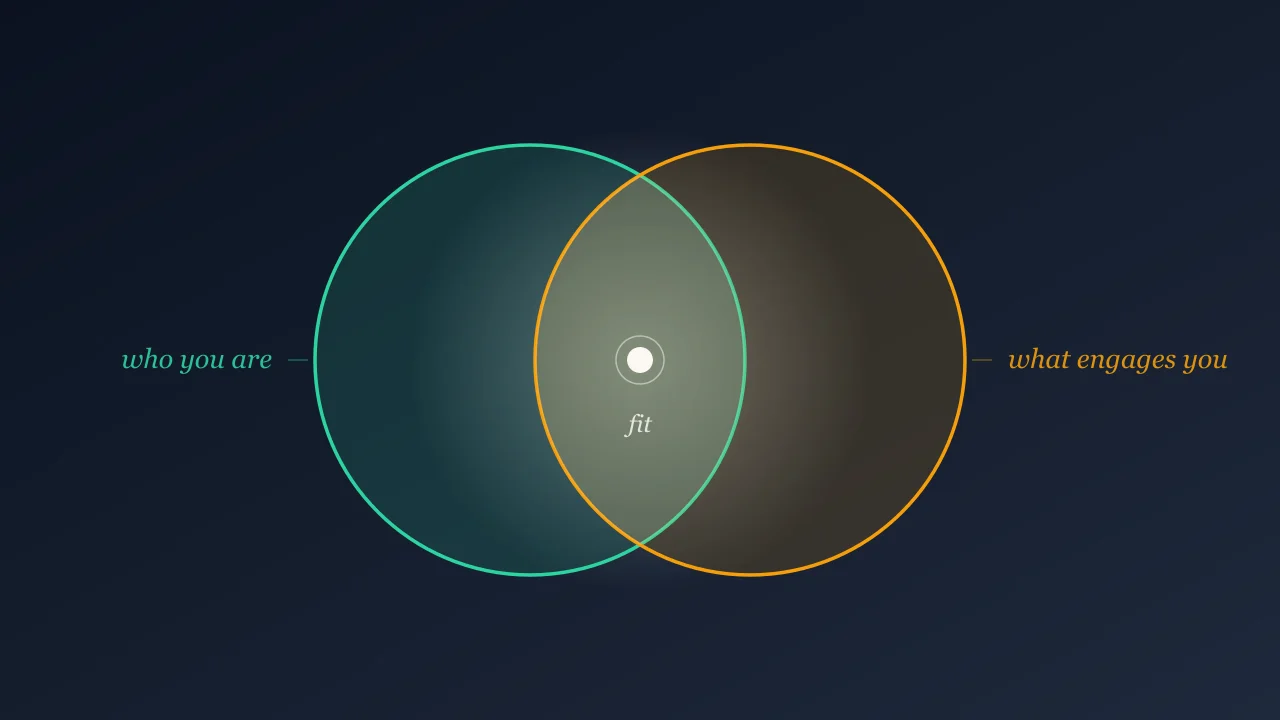
The O*NET Interest Profiler (Holland's RIASEC model) maps what genuinely engages a student across six interest areas — Realistic, Investigative, Artistic, Social, Enterprising and Conventional. It is one of the most researched frameworks in vocational psychology, it underpins the career-matching systems used by the US Department of Labor, and it produces a three-letter interest code that maps onto real occupational data. This is the what — what kind of work will still hold your attention in year seven of doing it.

The Prime Enneagram maps who a student is underneath the interest — their core motivation, what drives them, how they handle pressure, how they make decisions, what they need from an environment to do their best work. This is the why and the how.

Two credible models, measuring two genuinely different things. The question is what you do with them next.

Two profiles, one answer

Two students can produce the same three-letter interest code and be entirely different people. Both might come out Social-Artistic-Enterprising. One is motivated by being genuinely needed by others; the other by autonomy and being taken seriously as an authority. Show them the same career list and you have helped one of them and misled the other.

So in the Prime Career Guide the Enneagram profile doesn't sit in its own chapter waiting to be cross-referenced. It filters and reshapes the interest results before the report is written. Same interest code, different personality type, different shortlist — not as a judgement call someone makes on the day, but as a rule applied the same way for every student, every time. The report has a dedicated page for exactly this: where your two profiles meet, followed by a shortlist of top matches drawn from where both models agree.

Because the connection is built in rather than improvised, it can do something a stack of separate reports can't: flag a mismatch. When a student's interests point somewhere their personality will find genuinely draining, we say so, on the page, in writing. That isn't a flaw in the result — it is frequently the single most valuable line in the report, because it's the thing that otherwise only shows up in second year as "I don't know why I hate this."

And every recommendation runs across the four real pathways open to a South African matric — university, TVET, learnership and entrepreneurship — not the single road everyone assumes is the only one worth taking. A student whose profile points to a trade or a learnership gets that said plainly, alongside where the demand actually is in South Africa.

For the parent who doesn't know where to start

Something worth saying out loud: parents are not failing at this because they don't care. They're stuck because nobody has ever given them a place to begin.

You cannot advise a child into a labour market you haven't worked in for twenty years. Many of the jobs your teenager will realistically do weren't jobs when you chose yours. And the honest truth is that most of us default to the one map we have — our own career, or the career we wish we'd had — which is exactly how a well-meaning parent talks a child into somebody else's life.

The Prime Career Guide is written to be read by both of you. It gives a parent something to open the conversation with, instead of the interrogation that "so what are you going to do next year?" always becomes. It isn't a verdict on your child. It's a starting point, in language you can both follow, that moves the discussion from a decision-under-pressure to a conversation with a map on the table.

Where this leaves us

We're a South African product, built for South African students, priced so that a family doesn't have to choose between career guidance and the month's groceries. Two credible assessments, joined up for you rather than handed over as two separate reports, turned into something you can actually act on.

It isn't the whole journey. It's the first, best step.

If This Resonates — Let's Get It to More of Our Youth

If you're a business with a CSI or education mandate, a foundation or NGO, a school, or any organisation that wants to put real, personalised career guidance into the hands of South African youth at scale, we'd love to talk. We can co-brand, sponsor assessments for learners who couldn't otherwise access them, and build a delivery channel that gets this where it's needed most.

Let's talk about a partnership →

Start the Conversation

The best time to explore career options is NOW. Whether you're a student or a parent, the Prime Career Guide gives you a solid foundation for one of life's most important conversations.

Get your Prime Career Guide today →

Ready to discover your career path?

Get your personalised Prime Career Guide for just R225.

Buy Assessment